


Carbon Clean Solutions: Scaling Carbon Capture Technology to Reduce Emissions


As the global community intensifies its efforts to limit global warming to 1.5°C, the focus has shifted toward the most challenging sectors of our economy: heavy industry. While renewable energy is transforming the power grid, sectors like cement, steel, and chemical manufacturing remain inherently carbon-intensive due to the high-heat processes and chemical reactions involved.
Enter Carbon Clean Solutions, a global leader specializing in carbon capture technology to reduce emissions. By focusing on cost-efficiency and modularity, Carbon Clean is breaking down the barriers that have historically prevented industrial players from adopting carbon capture, utilization, and storage (CCUS) at scale.
The Industrial Decarbonization Challenge
Industrial processes are responsible for approximately 20% of global CO2 emissions. Unlike the power sector, where coal can be replaced by wind or solar, industrial emissions are often "process emissions" meaning the CO2 is a byproduct of the chemical transformation itself (such as limestone becoming cement).
To meet the goals of the Paris Agreement, these industries must find a way to trap CO2 before it enters the atmosphere. However, traditional carbon capture plants are often massive, expensive, and require significant custom engineering. This is where the innovation of Carbon Clean Solutions becomes a game-changer for sustainable engineering.
Innovation in Action: Carbon Capture Technology to Reduce Emissions
Carbon Clean’s approach is centered on overcoming the two biggest hurdles of CCUS: cost and space. Their breakthrough technology, known as CycloneCC, represents a shift from massive infrastructure to compact, high-efficiency systems.
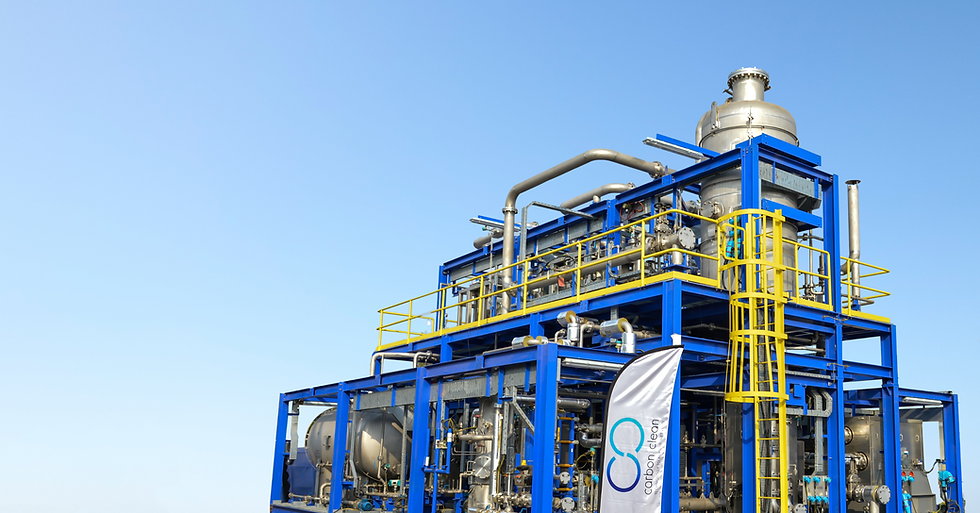
1. Modular Design (CycloneCC): Carbon Clean has developed a modular "plug-and-play" system. These units are prefabricated and skid-mounted, significantly reducing the footprint of the capture plant—often by up to 50% compared to conventional designs. For a mechatronics engineer, this represents a masterclass in system integration, as it allows for rapid deployment and easier scaling within existing industrial sites.
2. Advanced Solvent Technology: At the heart of their process is a proprietary, high-performance solvent. Traditional solvents are often corrosive and require high energy for regeneration. Carbon Clean’s advanced solvent is designed to be less corrosive and more energy-efficient, lowering the "energy penalty" of the capture process. This directly improves the energy efficiency in water treatment and industrial processing overall.
3. Digital Integration and Automation: By utilizing automated sensor systems and real-time data analytics, Carbon Clean units can optimize their performance based on the flue gas composition. This ensures maximum CO2 recovery while minimizing chemical and energy waste.
Driving Economic and Environmental Impact
The primary goal of carbon capture technology to reduce emissions is to make decarbonization economically viable. Carbon Clean’s modular approach lowers the capital expenditure (CAPEX) by nearly 30% compared to traditional capture methods.
Cement and Steel: These industries can now capture up to 90% of their emissions without needing to redesign their entire plant.
Carbon Utilization: Once captured, the CO2 isn't just waste. It can be utilized in the production of synthetic fuels, carbonated beverages, or even as a curing agent for "green" concrete, contributing to a circular economy.
Regulatory Compliance: As carbon taxes and ESG requirements become more stringent, Carbon Clean provides a pathway for companies to avoid heavy penalties and secure their future in a low-carbon market.
The Path Forward: Scaling for a Net-Zero Future

Carbon Clean Solutions is proving that environmental stewardship and industrial growth are not mutually exclusive. With over 44 sites operational worldwide, they are demonstrating that CCUS is no longer a "future technology" it is a present-day reality.
For those of us in the mechatronics and engineering fields, companies like Carbon Clean serve as an inspiration. They show how advancements in material science, chemical engineering, and automated control systems can converge to solve the most pressing problem of our time. By perfecting carbon capture technology to reduce emissions, Carbon Clean is not just mitigating climate change; they are engineering the foundation of a sustainable industrial future.


Comments